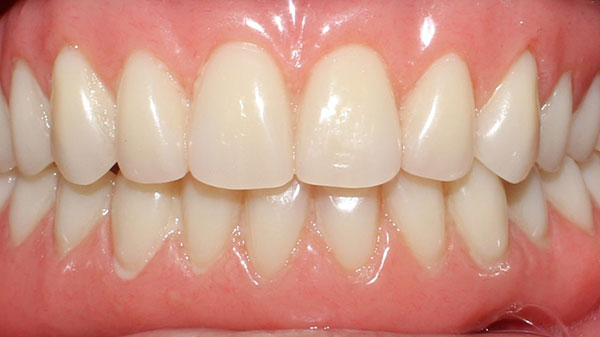
Restore function and confidence when smiling
Personalised solutions to replace missing teeth, restore damaged teeth and help you eat and smile comfortably again.
Oral rehabilitation combines treatments to restore chewing, bite stability and appearance when teeth are missing, severely worn or damaged.
At Centre Dental Vilanova, we assess each case as a whole. Treatment may range from a single crown to complete rehabilitation, using natural teeth, implants or both as support.
Types of dental prostheses
Fixed prostheses
Restorations that remain in the mouth and are not removed by the patient for daily cleaning.
Dental crowns
Cover and protect a weakened, extensively restored, worn or root-treated tooth. They can also be fitted onto an implant to replace a missing tooth.
Fixed bridges
Replace one or more teeth, supported by prepared teeth or implants. Support is chosen according to the clinical situation and preservation of neighbouring teeth.
Removable prostheses
Can be taken out for cleaning. An alternative when several or all teeth are missing and a fixed solution is not wanted or appropriate.
Partial dentures
Replace some teeth in an arch and are supported by the remaining teeth. They may incorporate a metal framework or other materials according to clinical indications.
Complete dentures
Replace all teeth in an arch. Their fit depends on tissue anatomy, saliva, muscles and changes over time.
Implant-supported prostheses
Implants may support a crown, fixed bridge, fixed full-arch prosthesis or removable overdenture with improved retention.
The number and distribution of implants are decided after clinical examination and imaging. For the surgical stage, see the Dental implants page.
What does treatment involve?
- Complete assessment. We check teeth, gums, bite, existing prostheses and patient needs.
- Records and diagnosis. We take radiographs, photographs, scans or models according to complexity.
- Treatment plan. We explain alternatives, stages, materials, estimated timescale and costs.
- Preparing the mouth. Decay, gum problems, infections or teeth with a poor prognosis are treated first when necessary.
- Temporary prosthesis. In some treatments, temporary restorations maintain function, protect teeth and help assess appearance and bite.
- Definitive prosthesis. We carry out the necessary trials before fitting or providing the final restoration.
- Reviews and maintenance. We check fit, bite, hygiene and supporting tissues.
Complete oral rehabilitation
When many teeth are missing, worn or have a compromised prognosis, comprehensive rehabilitation may be needed. The aim is not simply to replace teeth, but to restore a stable bite and comfortable function while respecting facial appearance.
These treatments may combine conservative dentistry, root canal treatment, periodontics, prostheses, implants or orthodontics. They are organised in stages and require monitoring throughout.
Materials and choice of prosthesis
Material choice depends on tooth position, bite forces, available space, appearance and support. Ceramics, zirconia, resins or metal frameworks may be used according to the case.
No single material is best for every patient. We explain the advantages, limitations and maintenance of each option before deciding.
Which solution might suit you?
- Damaged tooth: restoration, inlay or crown, depending on remaining structure.
- One missing tooth: single implant, bridge or removable prosthesis.
- Several missing teeth: bridge, partial denture or implant-supported solution.
- All teeth missing: complete denture, overdenture or fixed implant-supported prosthesis.
- Generalised wear: oral rehabilitation and bite assessment.
These examples do not replace diagnosis. Decisions follow an assessment of the whole mouth and patient priorities.
Digital technology
Intraoral scanning provides comfortable, accurate digital records for many treatments. CAD/CAM technology can be used to design restorations and communicate with the dental laboratory.
The number of visits and manufacturing time depend on the prosthesis and whether design or manufacture takes place in the clinic or an external laboratory.
Clinical cases


Dental Prostheses + Implants